Harmony by Design: A Primer on Vedic Architecture (Sthapatya Veda) for Modern Living

In our rapidly urbanizing world, modern architecture often solves for efficiency but ignores the human spirit. We build taller, denser, and faster, frequently resulting in environments that feel disconnected and stressful.
At AAA Architects, we believe the antidote to this modern malaise lies in one of the world’s oldest holistic design systems: Sthapatya Veda.
Often misunderstood merely as "Vastu Shastra" (which is just one part of it), Sthapatya Veda is the broader Vedic science of architecture and city planning. It is the knowledge of how to design buildings and cities that are in perfect harmony with natural laws and cosmic energies.
Here are the basics of this timeless science, illustrated by our recent concept designs.
The Cosmic Grid: The Mandala
At the heart of Sthapatya Veda is the Mandala—a geometric grid that maps cosmic energy. When we design based on these grids, we ensure that the flow of energy (prana) within a space is balanced and beneficial.
Instead of the chaotic sprawl typical of modern cities, Vedic planning uses intentional, concentric, or grid-based layouts.
The Padmaka (Lotus) Cluster Layout
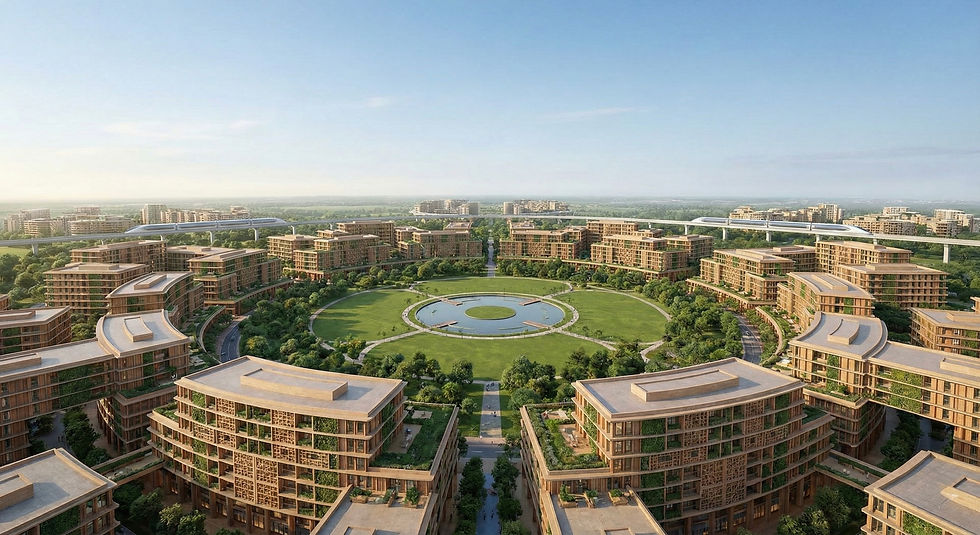
Take a look at our masterplan concept below. This is the Padmaka, or "Lotus Cluster."

• The Structure: Notice the concentric rings. It mimics nature’s fractals—like the petals of a lotus or the rings of a tree.
• The Flow: High-speed transit ("The Stem") pierces the rings, connecting nodes efficiently without disrupting the peaceful interior structure.
• The Balance: The layout transitions smoothly from mixed-use living areas out to an agricultural green belt, ensuring the city feeds itself and remains connected to the land.
The Brahmasthan: The Breathing Center
Every Vedic design, from a single room to an entire city, must have a central point of stillness. This center is called the Brahmasthan. It is the nucleus where cosmic energy enters and radiates outwards.
In Sthapatya Veda, this center must remain open, unbuilt, and unburdened.
Look back at the Padmaka Layout. The entire central core is a dedicated green space. It is not for commerce or housing; it is the "lungs" of the development. By keeping the centre open, the entire community breathes freely, reducing collective stress and promoting well-being.

Grounded towards the Sky: The Vedic Elevation
How does this translate to the buildings we live in? Vedic architecture emphasizes symmetry, strong foundations, and an upward aspiration. A building should feel grounded to the earth yet connected to the sky.
The Vedic Residential Concept
Observe the building elevation below. While modern in function, its form is deeply rooted in Vedic aesthetics.
• Symmetry and Stability: The structure is perfectly balanced. This visual symmetry creates a subconscious sense of stability and peace for the observer and inhabitant.
• The Solid Base: The lower floors feel heavier and more grounded, often utilizing earthy materials.
• Upward Aspiration: Notice how the building features a central, higher element resembling a shikhara (spire). This isn't just decoration; it’s a design element that draws the eye—and the energy—upward, connecting the dwelling to the celestial realm.
Why This Matters Today
At AAA Architects, we don't simply copy ancient temples. We adapt the principles of Sthapatya Veda—balance, orientation, the central void, and natural geometry—to solve 21st-century problems like urban heat islands, pollution, and social isolation.
By designing spaces that align with natural laws, we create environments that actively support the health, happiness, and prosperity of those who use them.


Comments